

A gallery containing at least 280 rock drawings around 19,000 years old has been discovered in the Cova de la Font Major cave in Catalonia, Spain. The finds were described in an article in the journal Antiquity.
The discovery was made by researcher Josep Maria Vergès Bosch of the Catalan Institute of Human Palaeoecology and Social Evolution.
The scientist was working for the first time in a little-known branch of the cave, which is popular with tourists. The walls of the gallery were covered with modern graffiti left by visitors since 1957. To examine the surface, Vergès Bosch angled the light of his head torch and noticed ancient lines among the modern inscriptions. Soon afterwards, on the opposite wall, he discovered an engraved image of a horse.
To date, specialists have identified 280 drawings, including 55 depictions of animals. Among them are horses, as well as an image of a doe with its head lowered.
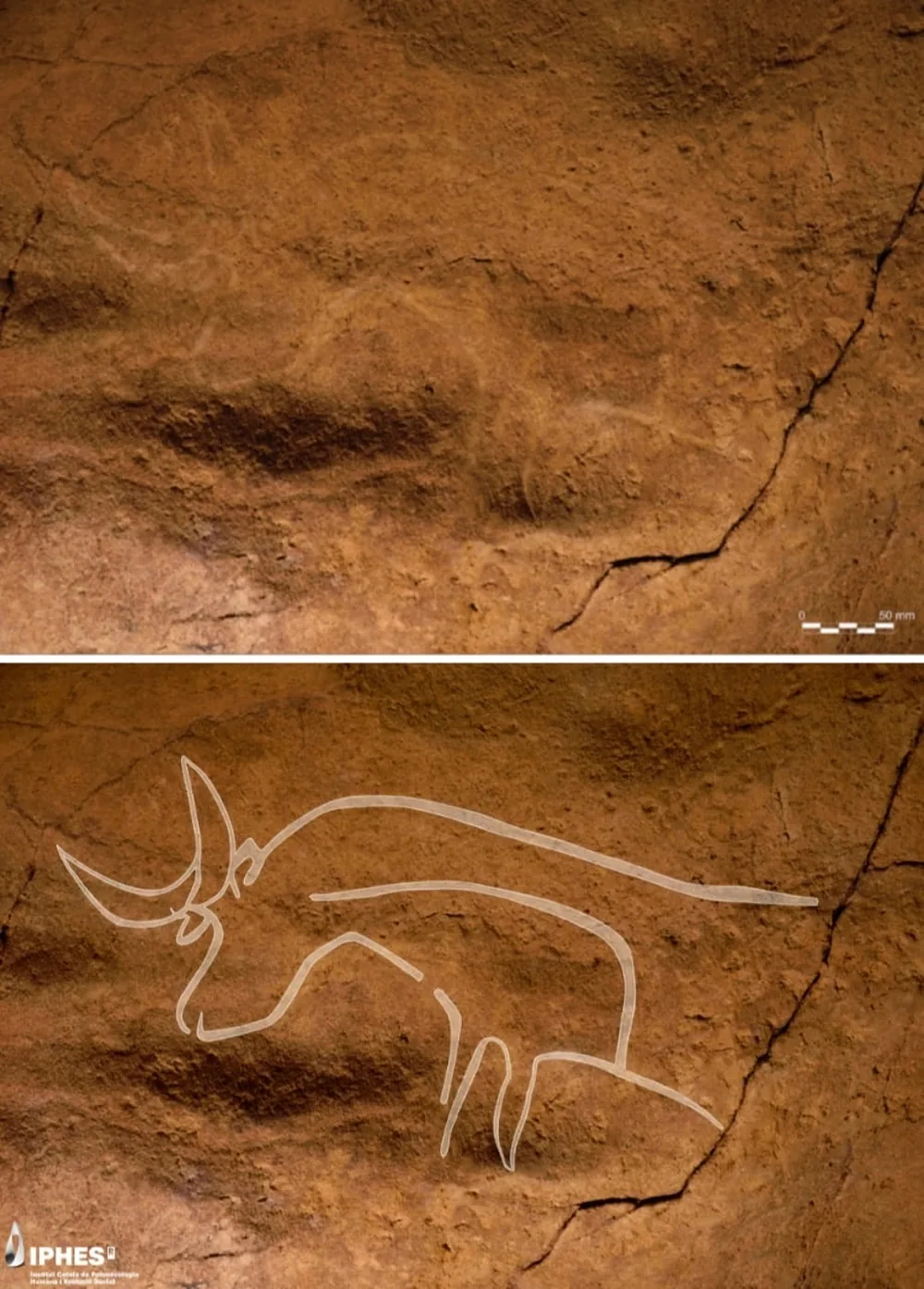
Researcher Miriam Salas-Altés suggested that a natural crack in the rock in front of the animal's muzzle may represent a pool of water from which the doe is drinking. If this interpretation is confirmed, the scene will become one of the earliest known depictions of water in the history of art.
In addition to the animals, numerous non-figurative engravings were found in the gallery: groups of two, three and four lines, series of 40 parallel strokes, Y-shaped signs, as well as circular and semicircular figures. Their meaning remains unknown for now.
The exact date the engravings were made has yet to be established. It is known that people lived in the cave between 26,000 and 41,000 years ago, and the stylistic features of the drawings suggest that they were made no later than 19,000 years ago.
According to the researchers, the discovery helps to fill gaps in understanding of the spread of Palaeolithic art on the Iberian Peninsula and shows that even long-known archaeological sites can conceal unknown evidence of ancient culture.


