

Archaeologists have discovered a monumental tomb about two thousand years old in Mongolia. The burial complex is about 73 metres long, and inside it researchers found 413 valuable artefacts linked to various cultures of ancient Eurasia, writes The Daily Galaxy.
The tomb is located at Duurlig Nars, an ancient necropolis in eastern Mongolia that was used by the Xiongnu. The burial dates to the late 1st or early 2nd century AD, when the influence of this powerful state was already in decline.
Excavations began in 2023 as part of a joint project of the National Museum of Korea, the Institute of Archaeology of the Mongolian Academy of Sciences and the National Museum of Mongolia. The researchers uncovered a long burial complex with an entrance corridor. The central part of the structure extends almost 15 metres into the ground.
The tomb consisted of two burial chambers, one inside the other. They were covered by nine layers of stone, which the archaeologists had to remove gradually to reach the wooden coffin at the centre. Directly above the central chamber was a lacquered carriage, indicating the high social status of the person buried there.
The identity of the deceased has not yet been established. However, the wealth and scale of the burial point to their considerable standing in Xiongnu society.
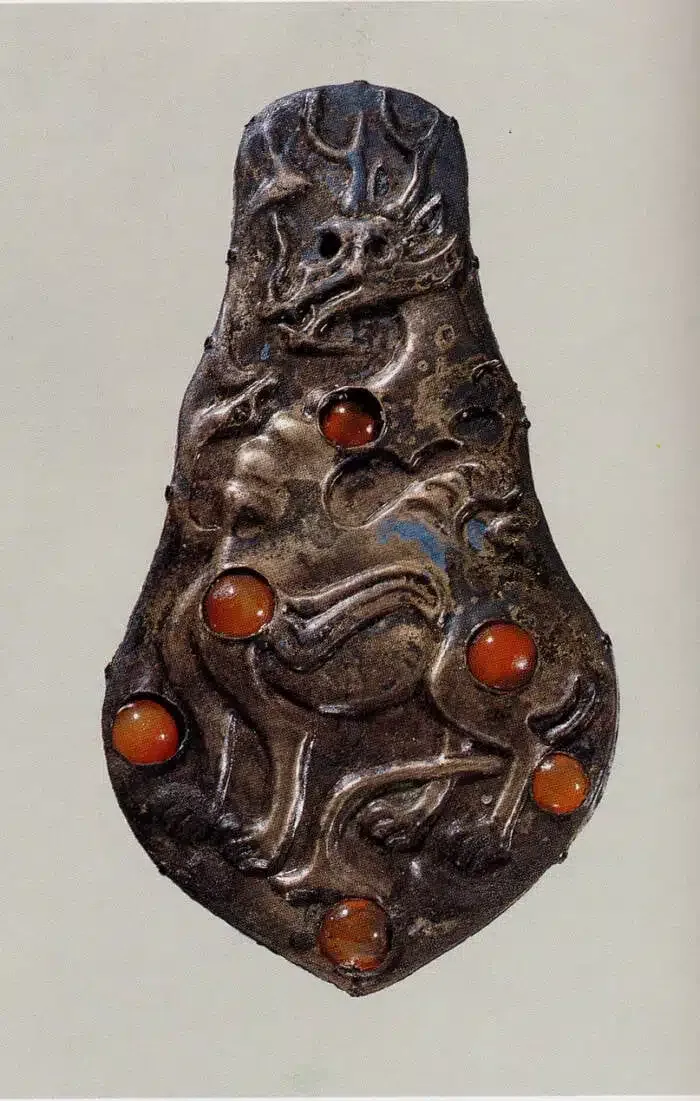
Among the 413 items found are jade ornaments of Chinese workmanship, silver horse harness fittings and a glass vessel with a handle which may have been brought from the Roman Empire. The exact origin of the vessel has not yet been established: scientists plan to determine its chemical composition.
At the bottom of the sarcophagus, archaeologists also found 15 decorated jade discs. They resemble items found in burials from the era of China's Han dynasty, although they differ in shape and have more detailed engraving.
The silver harness fittings bear patterns similar to those seen on finds in Korea. According to the researchers, such items may have moved between regions through trade, diplomatic contacts or the mediation of other civilisations.
The scientists were also interested in the design of the tomb itself. Its central chamber lies closer to the surface than in other elite Xiongnu burials in central Mongolia. The archaeologists suggest that the features of the structure may be linked to the weakening of Xiongnu political power at the time it was built.
The researchers have collected samples for DNA analysis. Studying them may help establish the origin of the person buried and provide additional information about the Xiongnu population.


