

Hyundai and Kia have filed a patent application for a system that automatically charges electric vehicles through the wheel hubs.
The design allows a car to be charged without human involvement: the charging station locates and unscrews a cap on the wheel hub by itself, connects the plug and, once the cycle is complete, puts the cap back in place.
Because the cap rotates with the wheel and comes to rest at a random angle, a separate sensor searches it for a slot, and a motor turns the gripper in the required direction to insert a pin. The mechanism then unscrews the cap from the thread on the hub and moves it aside.
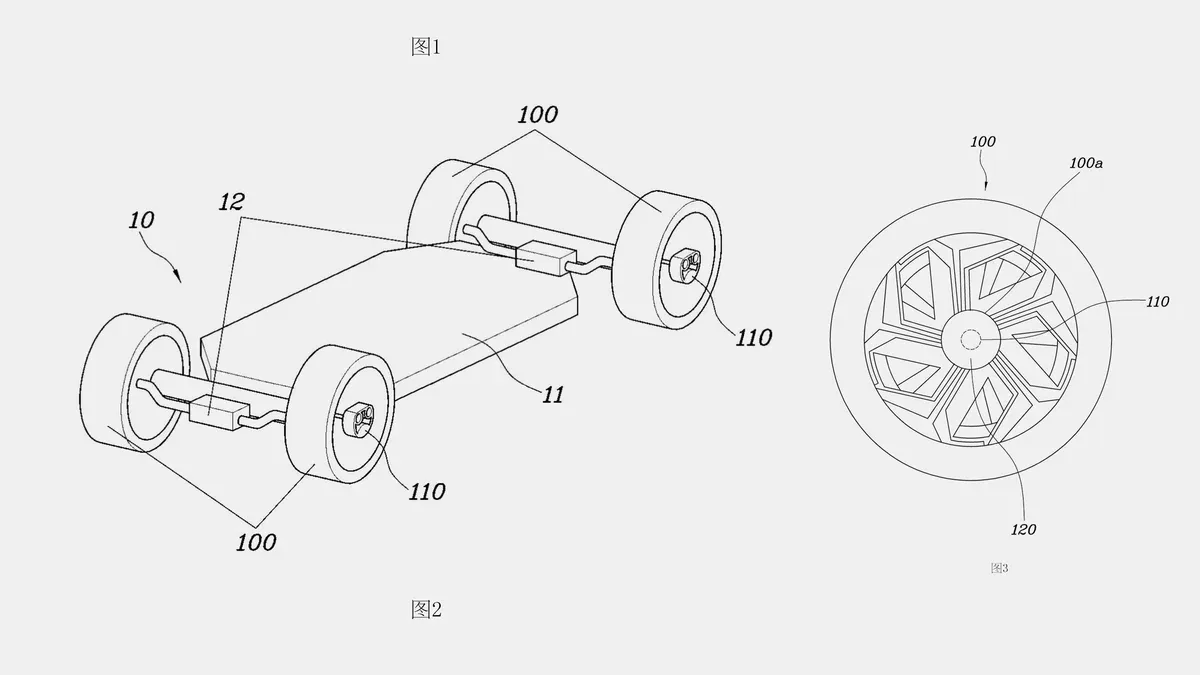
A third sensor guides the plug towards the socket, after which the plug extends and is secured by a hook, latch or magnet. The gripper plate also covers the plug compartment when the station is not in use. Disconnection takes place in reverse order.
According to the inventors, a socket could be fitted in every wheel, front and rear. It is connected via the steering knuckle to the battery and to an AC-to-DC converter mounted on the axle. In one version the socket remains stationary while the wheel rotates around it; in another it rotates together with the wheel.
The document does not specify the charging power or the connector standard. Nor does it describe how the unit would be combined with the drive shafts on driven wheels. It also does not explain how the mechanism would cope with road salt, ice, brake dust and contact with kerbs.


