Between the question ‘How much is it?’ and the long-awaited ‘We’ll take it’, a surprising amount sometimes happens.
Another price.
A call to the director.
Advice from an acquaintance.
A little haggling.
Tea.
Sometimes a second tea.
We looked at real 📈ALSAT data to understand what happens before that very ‘we’ll take it’. Some of the figures turned out to be rather unexpected.
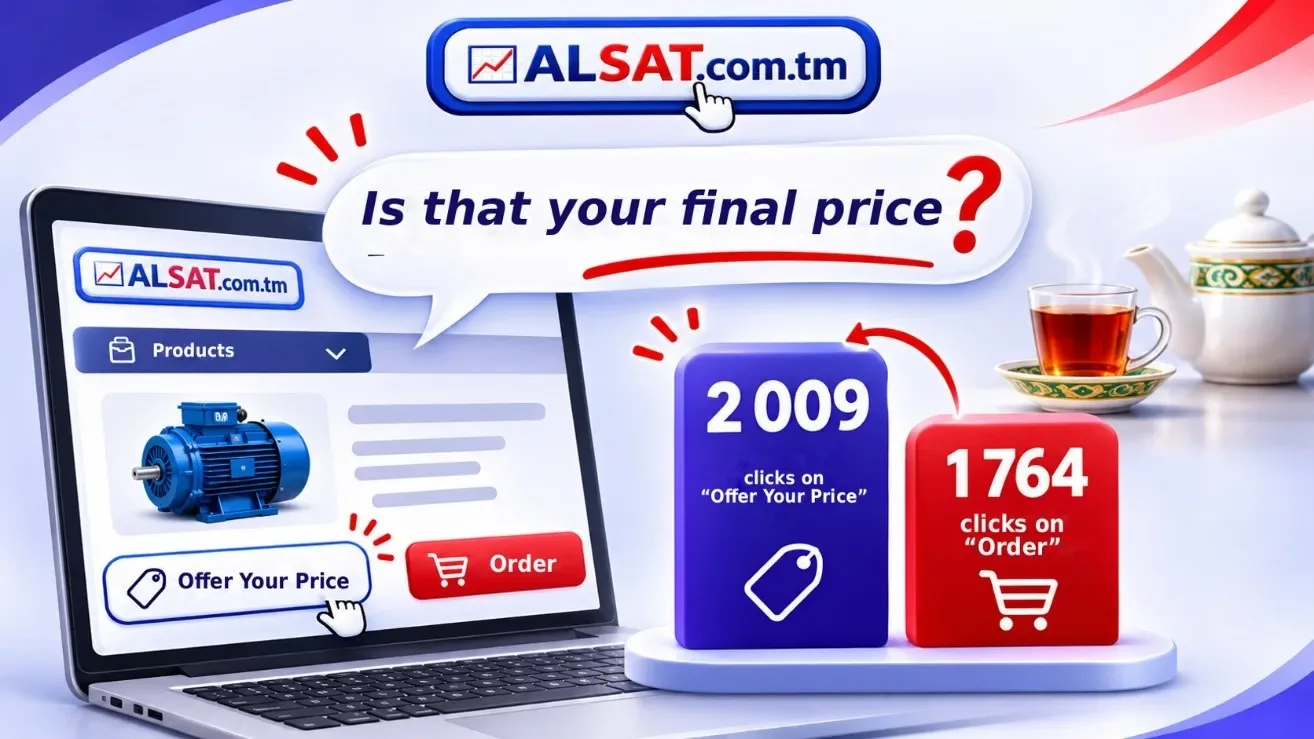
1. Let’s haggle first: 2 009 versus 1 764
On ALSAT, the ‘Offer a price’ button was pressed 2 009 times.
The ‘Order’ button — 1 764 times.
In other words, users more often tried to haggle than to buy a product straight away.
If you have ever sold anything in Turkmenistan, or in the countries of the East in general, you are probably not too surprised right now.
Quite the opposite.
Here, the question ‘And what’s the final price?’ sometimes comes up before the seller has even finished the sentence.
But there is a serious lesson here for the seller.
A buyer rarely judges a price on its own. They compare it with another price, another supplier, another volume or a figure they have already settled in their head.
In behavioural economics this is called an anchor.
💡 What to use
Do not show the buyer a single bare price.
Show how much one unit costs when buying one, ten and a hundred items. Add information on savings, payment terms and delivery times.
A price without context is just a number.
And you can always ask for a number to be made smaller.
2. 69 555 views lost to 413
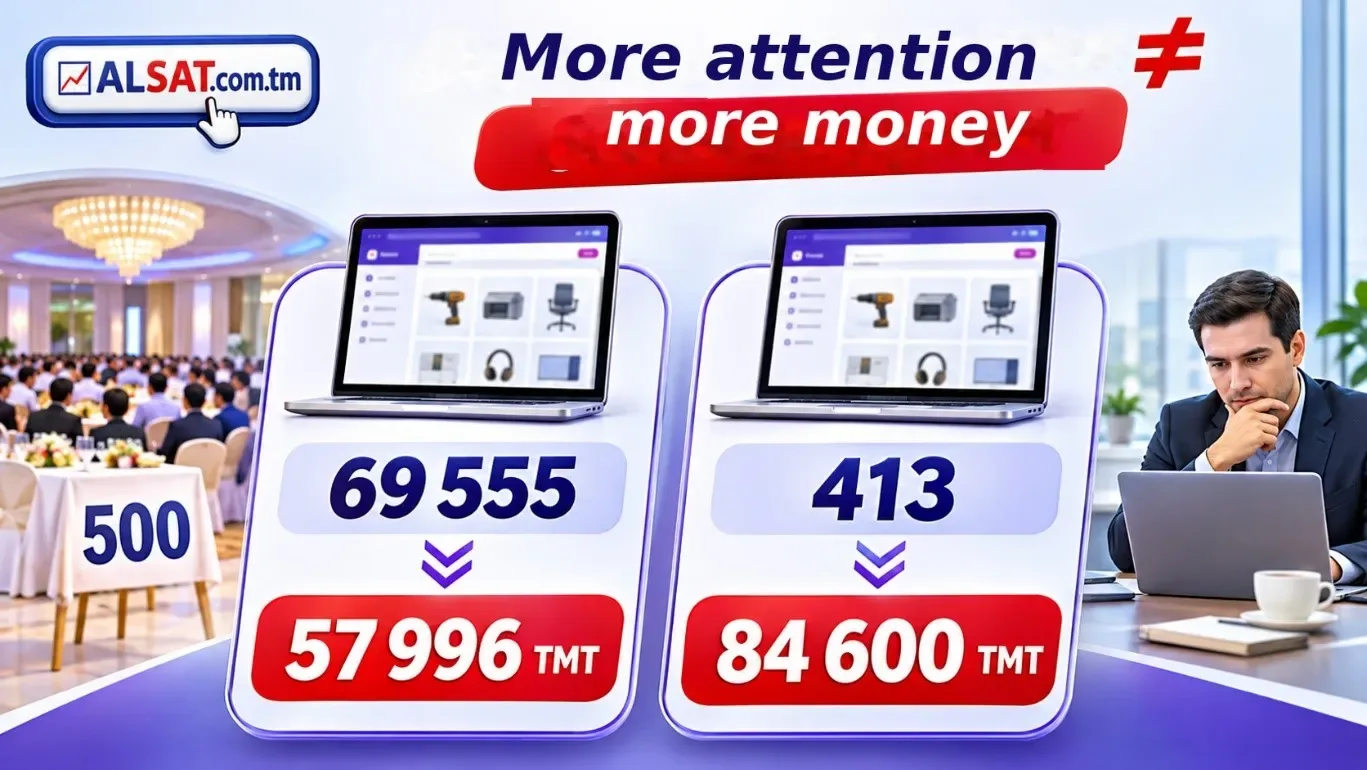
One seller’s products received 69 555 unique views.
Total completed sales — 57 996 TMT.
Another seller had just 413 views.
There was one completed sale.
But it was worth 84 600 TMT.
Almost 170 times fewer views — and more money.
This is a good moment to carefully set aside the report on view counts.
Because a business does not need the whole internet.
It needs the right people from the internet.
In our region, this is a rather familiar logic anyway.
At a wedding, it is wonderful to have 500 guests.
In a procurement department, one is sometimes enough.
💡 What to use
Before advertising, ask not ‘Who can this product be shown to?’ but ‘Which company particularly needs this product, and why right now?’ This is segmentation in its most practical form.
Artificial intelligence may indeed take over the world one day. But even it will first have to solve an old marketing problem: who exactly should all this be sold to?
3. Four sales lost to three
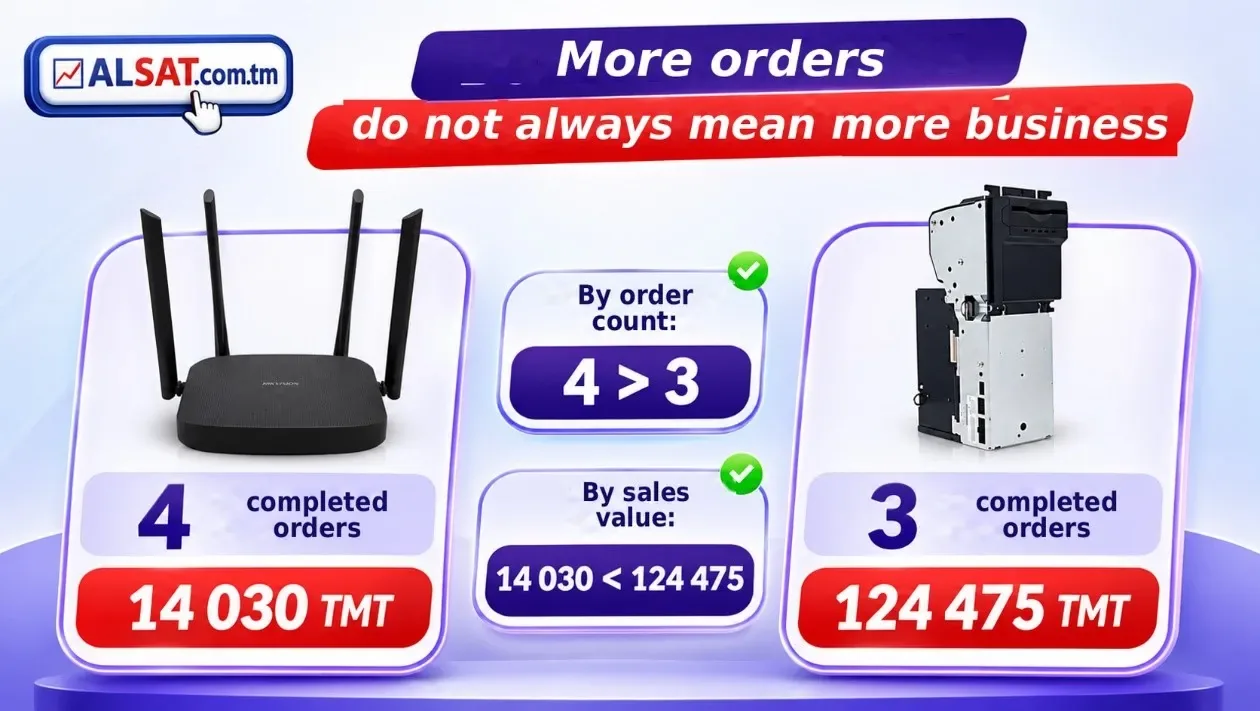
One Wi-Fi router on 📈ALSAT was bought 4 times.
Total completed sales — 14 030 TMT.
A banknote acceptor was bought 3 times.
Just one order fewer.
But total sales came to 124 475 TMT.
Almost 9 times more.
The conclusion is rather inconvenient for attractive monthly reports:
more orders do not always mean more business.
One client buys exercise books.
Another buys equipment.
Both are important.
But the calculator treats them somewhat differently.
💡 What to use
Before promoting a product, assess four things:
value of the potential deal × probability of purchase × possibility of a repeat sale × future value of the client.
This is close to the value proposition principle: what is worth selling is not so much a product’s feature as a valuable result for the buyer.
So instead of the question:
‘How do we sell more units?’
it is sometimes more useful to ask:
‘What more costly problem of the client can this product solve?’
4. 38 sales lost to 19
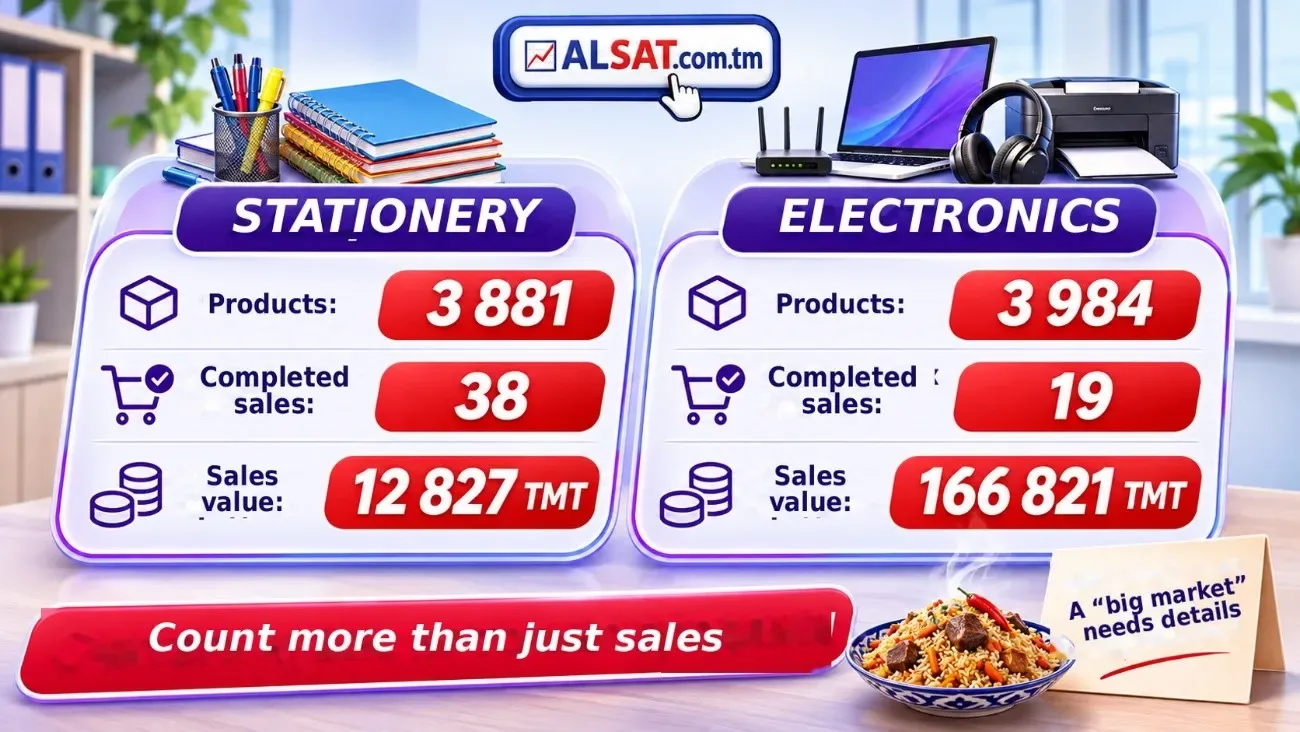
School supplies and stationery: 3 881 products, 38 completed sales worth around 12 827 TMT. Electronics: 3 984 products, 19 completed sales worth around 166 821 TMT.
The number of products is almost the same. Electronics has half as many sales, but the total is roughly 13 times higher.
That is why the phrase ‘We have a big market’ on its own says about as much as ‘We have good plov’. One would like some details.
💡 What to use
It is useful to assess a market by purchase frequency, deal value, probability of purchase and repeatability. And price — relative to alternatives. A buyer rarely decides: ‘Is this expensive or cheap in general?’ They decide: ‘Expensive or cheap compared with what?’
5. The most profitable ‘we’ll take it’ is sometimes heard the second time
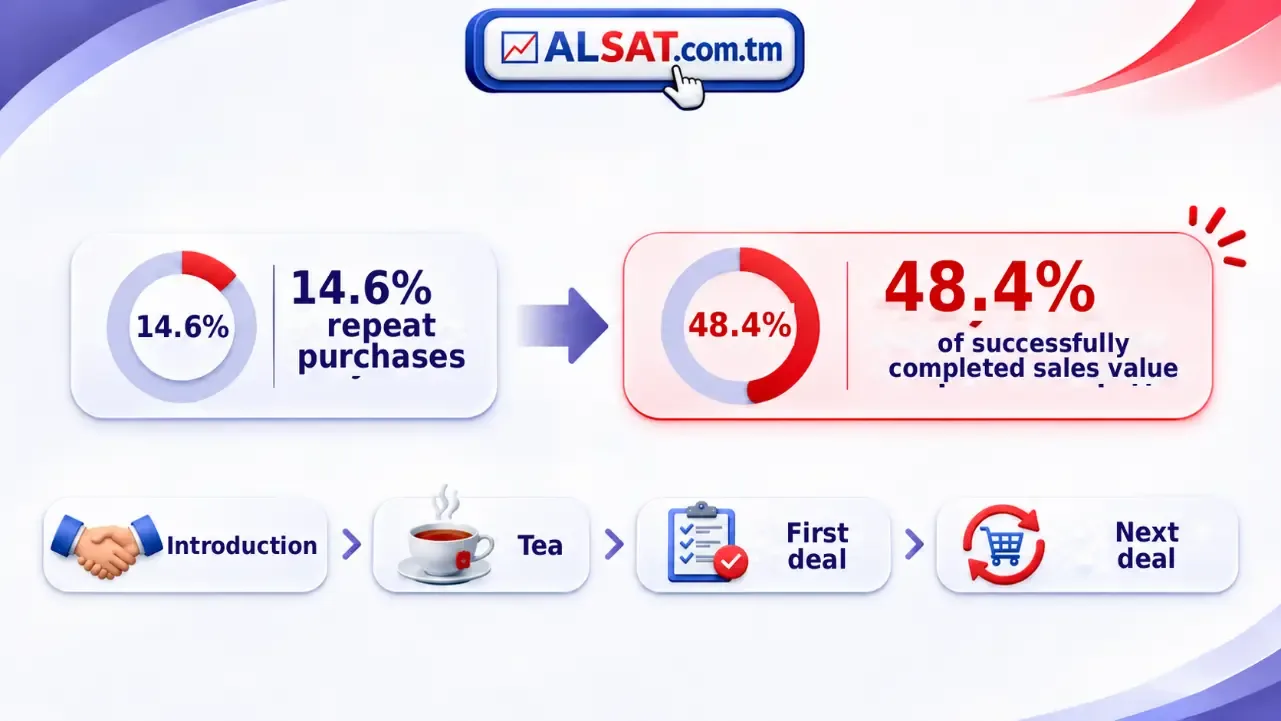
Repeat purchases account for about 14,6% of grouped purchases on ALSAT. Yet they account for about 48,4% of the value of successfully completed sales. A relatively small share of repeat purchases produced almost half of the sales value.
First you got acquainted. Then you talked. Then you had tea. Then you made the first deal. And then, at last, you can work properly.
💡 What to use
After the first sale, do not stop at asking ‘Were you happy with everything?’. Ask: ‘What will you need next?’. And set yourself a reminder before the buyer needs the product again.
The first sale brings money. A good first sale brings the next one.
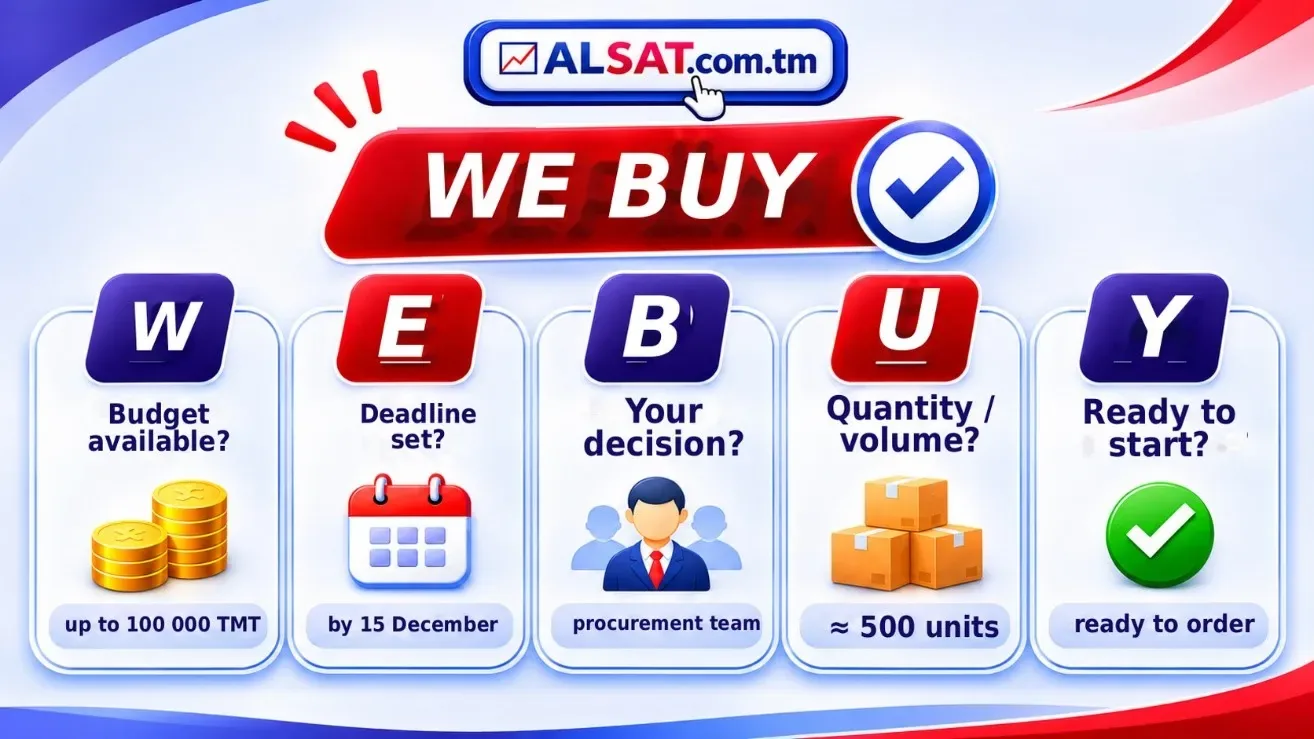
The TAKEN (‘We’ll take it’) cheat sheet: five questions to ask before promoting a product
Before investing in promotion, check your offer against five points.
T — Target. What specific problem does the product solve, and who exactly needs it? Not just ‘a quality air conditioner’, but equipment suitable for a 70 m² room, so that the office does not turn into a sauna in July.
A — Assurance. Why should the buyer believe you? Show reviews, real photos, certificates, guarantees and proven sales experience.
K — Key difference. Why should the buyer choose you rather than someone else? Price, availability, delivery, warranty or wholesale terms? If the seller does not know the answer, the buyer is unlikely to investigate on their behalf.
E — Expected benefit. What does the buyer actually get in practice? Not just ‘2,000 W of power’, but a concrete result: less work, lower risk or time saved. A feature tells you about the product. A benefit tells you about the buyer.
N — Next step. Is it easy to buy now? Is the price clear? Is the product in stock? Are the terms known? Does the manager respond? Is the next step obvious? Every unnecessary complication gives the buyer one more chance to say: ‘I’ll think about it’.
And in our part of the world, we know very well how long thinking can sometimes take.
So how do you find all this out about your own products?
This is where the numbers become more interesting than pretty charts.
It is useful for a seller to understand:
who is looking at the product;
what it is being compared with;
where people try to change the price;
what is bought;
what is not bought;
which product is worth promoting;
and which companies it should be shown to directly.
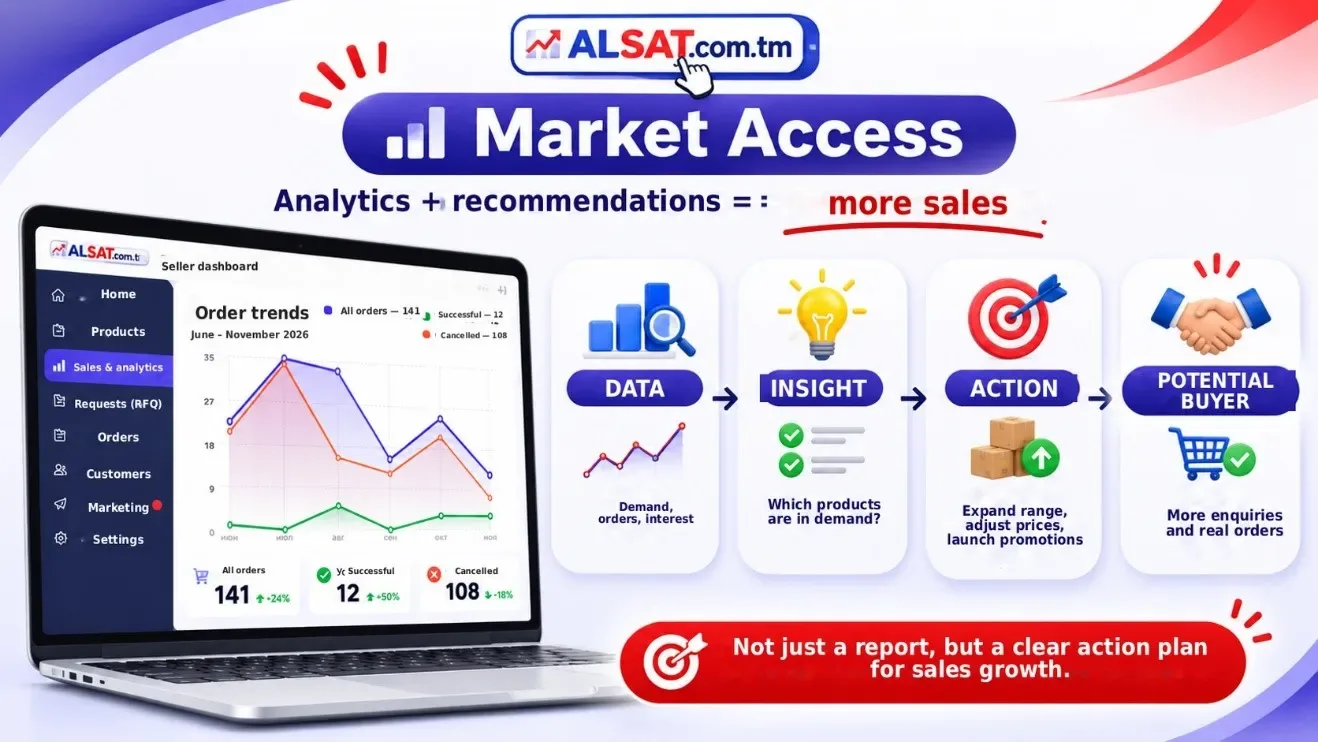
That is exactly why 📈ALSAT is developing Market Access.
For the local market, we help analyse the offering and data, find potentially suitable companies, present products to them and observe the market’s real reaction.
Not just:
‘Let’s run an ad’.
But first:
‘What exactly are we selling, to whom, why should they buy it, and what is stopping them from doing so now?’
And what if there are already few buyers at home?
The same logic can be applied to another market too. Before going to a trade fair, ordering a large stand and finding out the quality of the coffee at yet another airport, you can check who buys similar products, which importers and distributors are suitable, how your offer looks against theirs and whether there is any interest at all.
That is already MarketAccess for export.
But export is a story for next time.
For now, the question is simpler:
Is your buyer ready to say ‘we’ll take it’ — or are they still missing something?
📩 sell@alsat.biz
📈ALSAT — simple for business.