

An ordinary fragment of a humerus of the pterosaur Azhdarcho lancicollis, forgotten since 1958, has turned out to be the first find of an azhdarchid in Asia in the history of palaeontology. This was established by scientists from the Zoological Institute and the A.A. Borissiak Paleontological Institute of the Russian Academy of Sciences.
They shared the results of their research in the journal «Reports of the Russian Academy of Sciences. Life Sciences».
The fossil was discovered on 18 September 1958 during an expedition led by the Soviet palaeontologist Anatoly Rozhdestvensky at the Dzharakuduk locality. Afterwards, the specimen was kept for decades in the collection of the Paleontological Institute of the Russian Academy of Sciences among unidentified finds and was only recently re-examined.
Azhdarchids are an extinct family of flying reptiles that existed at the end of the Cretaceous period, around 90 million years ago. The family included some of the largest flying animals in the history of the Earth: the wingspan of some azhdarchids reached 10–11 metres. Among them was the giant Quetzalcoatlus.
It is worth noting that the name of the family of these creatures is directly linked to the mythological figure of the azhdarkha, a serpent-like dragon known in the folklore of the peoples of Central Asia, including Turkmenistan and Uzbekistan. In the 1970s and 1980s, the Soviet palaeontologist Lev Nesov carried out excavations in the Kyzylkum Desert on the territory of present-day Uzbekistan and Kazakhstan. There he discovered the remains of a long-necked flying reptile previously unknown to science. In 1984, the scientist named the new genus Azhdarcho, using the local name of the mythical creature.
Later, similar giant pterosaurs were discovered in various parts of the world. They were grouped into the family Azhdarchidae, the azhdarchids.
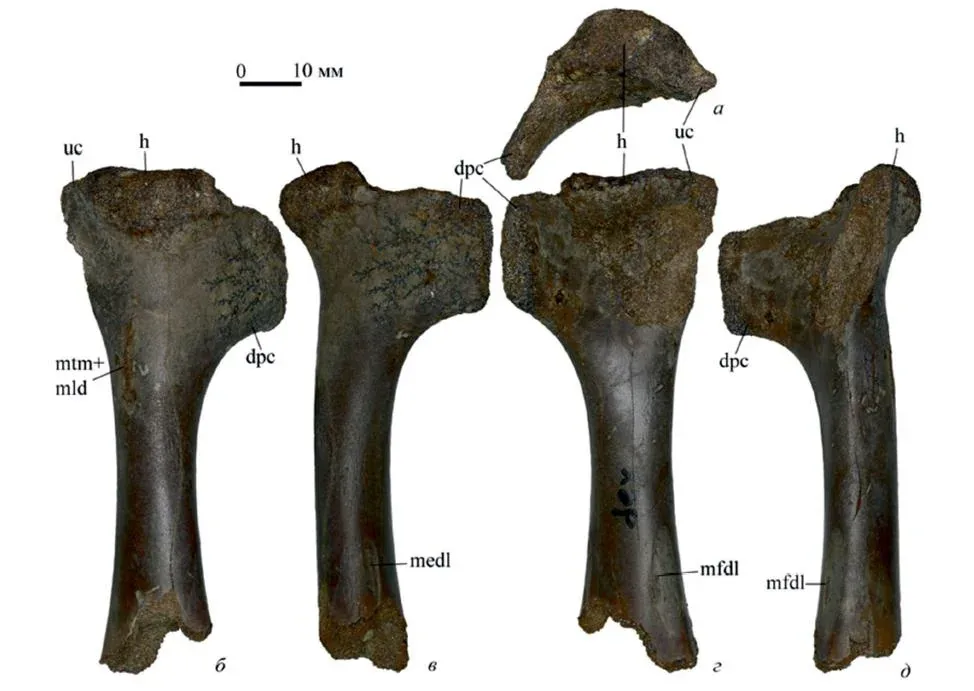
The specimen studied belongs to the species Azhdarcho lancicollis, whose name translates from Latin as «possessing a spear-shaped neck».
For a detailed study, the scientists used an X-ray microtomograph. This method made it possible to obtain a three-dimensional model of the fossil without damaging the specimen. Characteristic impressions of the attachment sites of large muscles were found on the bone, including muscles associated with the movement of the predominantly elongated fourth finger, to which the flight membrane was attached.
The data obtained helped to clarify the structural features of azhdarchids and the workings of their wings.


